+86 13392271119
sales@eprochina.com

News
- News
- Product


Editor's note: this article is compiled from third-party industry sources. Product claims quoted herein are those of the brands mentioned and do not represent EPRO's own statements.
【行业动态】本文整理自 Kodio(kodiohome.com),原文链接:https://kodiohome.com/global-air-fryer-market-trends
The global air fryer market keeps climbing — valued at USD 9.40 billion in 2025 and projected to reach USD 20.99 billion by 2034 (CAGR 8.99%, Fortune Business Insights). Two forces drive momentum: a replacement wave in mature markets (North America and Western Europe, where households are trading basic 2-litre units for multi-zone, family-sized upgrades) and first-time adoption across Latin America, Southeast Asia, and the Middle East, powered by rising incomes and rapid urbanization.
Four structural drivers sustain demand: health positioning (rapid air circulation cuts oil use by 80–90% versus deep frying), energy savings (a 3–6L unit preheats in under 3 minutes and draws far less power than a 3,000W oven), compact urban footprints, and viral short-form recipe content that keeps driving hardware upgrades.
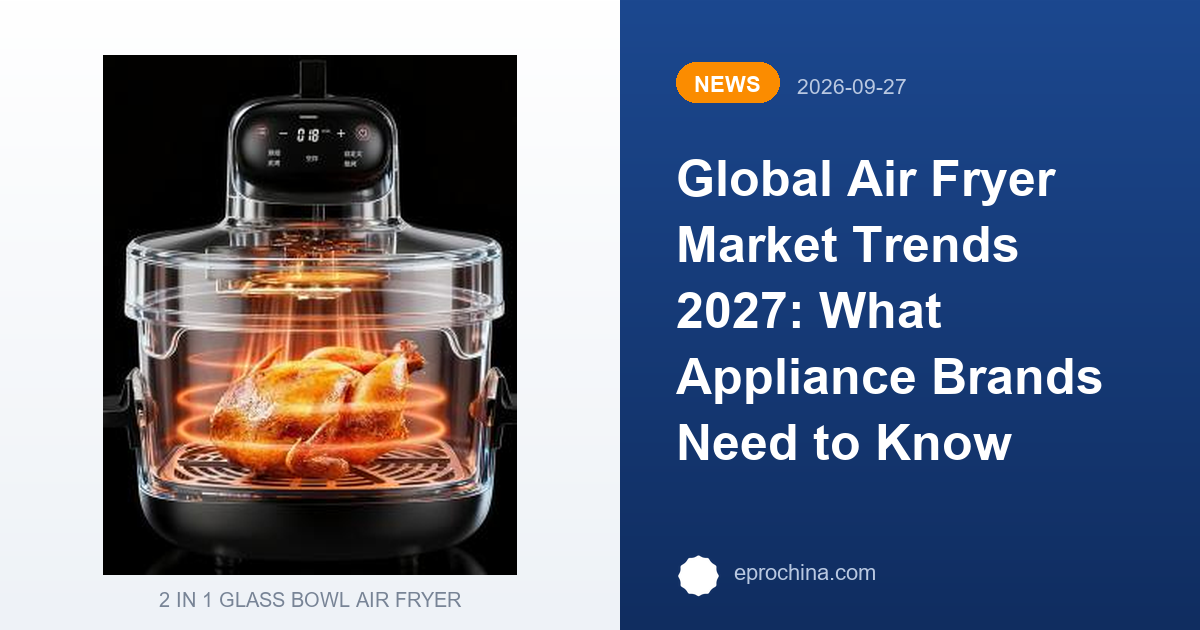
For 2027, five product vectors define the new standard: (1) digital LED / touch interfaces replacing mechanical dials; (2) dual-basket synchronized cooking with two independent chambers that finish simultaneously; (3) borosilicate viewing windows that let users monitor browning without opening the basket and losing 20–40°C of heat; (4) multi-function cooking (bake, broil, rotisserie, dehydrate) using dual heating elements; and (5) smart IoT connectivity (Wi-Fi / Bluetooth) for remote monitoring and recipe sync.
Regionally, North America favors 5.5–9.0L dual-basket units with ETL / FDA certification; Europe prioritizes compact, quiet, energy-efficient models with CE / RoHS / LFGB compliance including PFAS-free coatings; Latin America needs 127V / 60Hz voltage engineering and strong price-to-performance; the Middle East and Asia-Pacific want 3.5–6.0L versatile capacities with metallic trims and CB / G-Mark compliance.
For brands and distributors, sourcing strategy splits into white-label (30–45 days), OEM custom (60–90 days), and ODM proprietary (120–180 days). Vetting partners on high-voltage dielectric testing, food-grade certifications (SGS / TÜV), and ISTA drop-test packaging is essential to protect margin and market share as the category matures.
Keep paying attention to EPRO for more latest news about air fryer.



Privacy Policy | Terms of Service



 English


